
There is no reliable number for how long it takes to refocus after an interruption, and the famous one is wrong. The 23 minutes and 15 seconds you have seen quoted in every focus-app landing page does not appear in the peer-reviewed paper it is attributed to. That paper, Mark, Gonzalez and Harris at CHI 2005, reported an average of 25 minutes 26 seconds to return to an interrupted task, with a standard deviation of 54 minutes 48 seconds, and a spread that wide means the average predicts almost nothing about your afternoon.
You are forty minutes into a memory leak. You have four terminals open, a heap dump half read, and a mental model of the allocation path that exists nowhere except in your head. Someone posts “quick question” in a channel you are obliged to watch. You answer in ninety seconds. Then you sit there looking at the heap dump like it belongs to somebody else.
Most of us have reached for the 23-minute statistic to explain that feeling to a manager. It is worth knowing what you are citing.
Where the 23-minute number does not come from

Not from the paper it is cited to. That paper is “No task left behind? Examining the nature of fragmented work”, a field study of 24 information workers at an IT and accounting outsourcing firm, and its full text contains no 23-minute figure of any kind. What it reports is an average resumption time of 25 minutes 26 seconds with a standard deviation of 54 minutes 48 seconds.
Where the 23:15 version did originate is a question we cannot answer with a link, and we are not going to guess. No published study we could find reports it, and we found no citable record of its first appearance. So the claim this article can defend is the negative one, which is also the only one that matters when someone quotes the number at you: it is not in the paper it is attached to. The precision is part of why it travels. Fifteen seconds sounds measured.
The same study found workers spent an average of 11 minutes 4 seconds on a working sphere before switching or being interrupted, and had visited an average of 2.26 other working spheres before returning. That is a useful picture of a fragmented day. It is not a stopwatch you can hold to your own head.
How long does it take to refocus after an interruption?

The honest answer is that the research measured a distribution, not a duration, and the distribution is a mess. Mean 25 minutes 26 seconds. Standard deviation 54 minutes 48 seconds. The deviation is more than twice the mean, which means the data are heavily skewed: many quick resumptions, and a long tail of tasks left sitting for hours. Under those conditions the mean summarises the dataset and nothing else. It describes no individual worker and predicts no individual interruption.
So swapping the paper’s mean in for the folklore number does not fix the problem. It reproduces it with better provenance. If you want to argue for focus blocks, the strongest evidence-led version of that argument is not “each ping costs me 25 minutes.” It is “resumption time in the observed data varied so wildly that scheduling around interruptions is not possible, which is itself the cost.”
Two caveats also belong on that number. The study observed 24 people at a single company, and it was published in 2005, when the interruption surface was email and a phone, before persistent chat existed.
The result that ruins the story

Three years later the same lead author ran a controlled experiment, published as “The cost of interrupted work: more speed and stress”. Participants worked on a simulated email task, some of them interrupted, some not. The interrupted group completed the work in less time. There was no difference in quality.
Nothing in that experiment supports the claim that interruptions reduce your output. The authors’ interpretation is that people compensate: interrupted, you speed up, and you finish.
What did change was everything the participants reported about the experience. Higher stress. More frustration. Greater time pressure. More effort. Same work, same quality, faster, and considerably worse to live through. That is the actual finding, and it points the whole conversation somewhere other than productivity.
The measured cost of interruption in that experiment was not throughput. It was strain.
Scope matters here as much as with the field study. This was a laboratory experiment on a short simulated task, and the stress and frustration were self-reported on questionnaires, not measured physiologically. “Interruptions make you faster” does not generalise to a two-week refactor. The direction of the finding is still clear enough to kill the folklore version.
Why the millisecond studies do not rescue the argument
When the throughput story fails, people usually reach for cognitive psychology next. Monsell’s review of the task-switching literature reports that responses are substantially slower and usually more error-prone immediately after a switch, and that an opportunity to prepare reduces the switch cost without eliminating it. Rubinstein, Meyer and Evans found across four experiments that switching-time costs grew with rule complexity and shrank with task cueing.
Both are real results. Neither is about your day. These are switches between trivial laboratory tasks, measured in fractions of a second under controlled cueing, and nothing in them licenses the leap from a lab switch cost to a ruined afternoon. The percentage-of-your-day figures that circulate with these papers attached are not results reported in them, so check the claim against the paper before you repeat it.
There is also a body of work on attention residue, the difficulty of disengaging from an unfinished prior task, which Leroy examined in 2009. The finding at abstract level is that residue from an incomplete task impairs performance on the next one, that finishing the prior task was not by itself enough, and that time pressure while finishing it helped. We have not read the full text, so we are not quoting effect sizes from it, and residue should not be described as a measurable number of minutes.
If the cost is strain, use the words that mean something
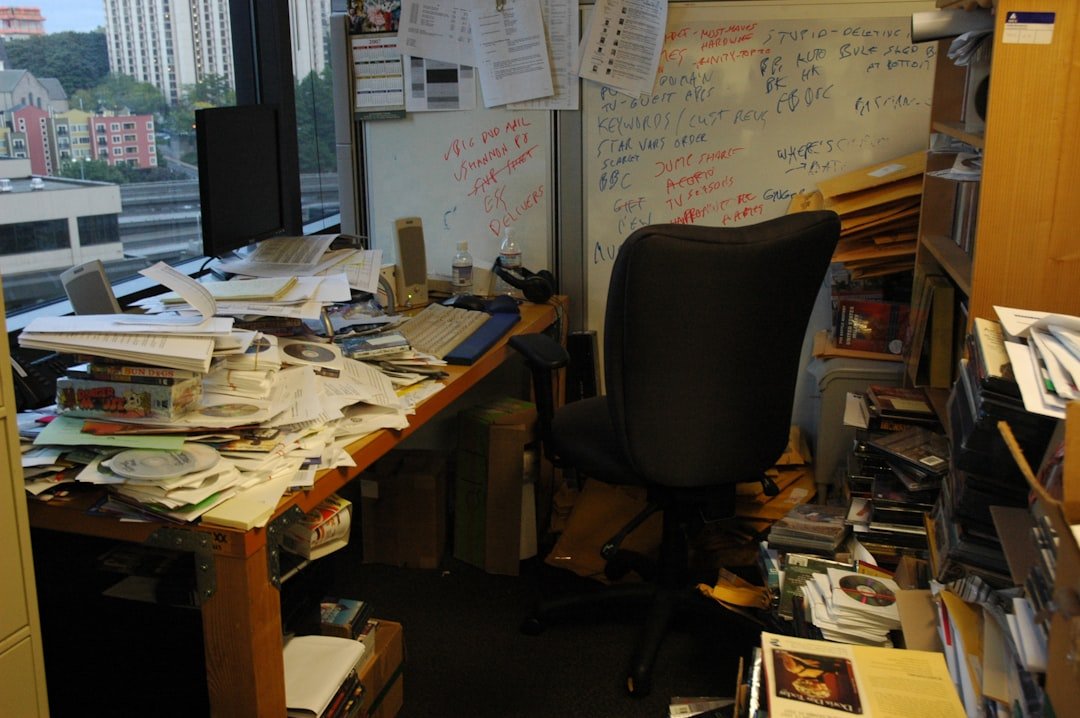
Strain has definitions, and they are narrower than the way the words get used in Slack. NIOSH defines job stress as the harmful physical and emotional responses that occur when the requirements of a job do not match the capabilities, resources or needs of the worker. That fits the interrupted debugging session: the demand did not change, but the resource you needed to meet it (uninterrupted attention) was withdrawn.
Burnout is narrower still. WHO classifies burn-out in ICD-11 as an occupational phenomenon and explicitly not as a medical condition: a syndrome resulting from chronic workplace stress that has not been successfully managed, with three dimensions: energy depletion or exhaustion, increased mental distance from or cynicism about one’s job, and reduced professional efficacy. WHO also says the term should be applied to the occupational context and nowhere else. Nothing in the interruption literature tested interruption load as a cause of burn-out, so the link here is definitional, not causal.
The recovery side is thinner than it is usually presented. A meta-analysis of 86 publications covering 91 samples and 38,124 employees found average positive correlations, small to medium, between psychological detachment from work during non-work time and self-reported mental health, physical health, state well-being and task performance. It also found no significant average relationship between detachment and physiological stress indicators, a medium negative relationship between working during off hours and detaching, and, counterintuitively, negative correlations with contextual performance and creativity. This is correlational, mostly cross-sectional self-report, with moderate to high heterogeneity. Switching off in the evening is associated with feeling better. It is not demonstrated to move a stress hormone.
Common questions
Is the 23-minute refocus statistic real?
No. “23 minutes and 15 seconds” does not appear in Mark, Gonzalez and Harris (CHI 2005), the paper it is almost always attributed to. That field study of 24 workers reported an average resumption time of 25 minutes 26 seconds with a standard deviation of 54 minutes 48 seconds, a spread so wide that its own average describes no individual. We could not trace the 23-minute version to any published study, so the reliable statement is simply that it is not in the paper it is credited to.
Why does the standard deviation matter more than the average?
Because in that study the standard deviation of resumption time (54 minutes 48 seconds) was more than twice the mean (25 minutes 26 seconds), which means the distribution is heavily skewed and the average describes no individual worker. Quoting the mean as “how long it takes to refocus” misrepresents what was measured.
Do interruptions make you less productive?
Not in the experiment that tested it directly. Mark, Gudith and Klocke (CHI 2008) found that interrupted participants completed a simulated email task in less time than uninterrupted participants, with no difference in quality, while reporting more stress, frustration, time pressure and effort. That was a short laboratory task, so it does not settle what happens over a long project.
Can I say Slack notifications cause burnout?
No published source in this area tested interruption load as a cause of burn-out, and WHO defines burn-out narrowly as an occupational phenomenon resulting from chronic workplace stress that has not been successfully managed. You can accurately say that interruption is associated with self-reported stress and frustration; you cannot say it causes a syndrome nobody measured here.
Does laboratory task-switching research apply to context switching in engineering work?
Only loosely. Task-switching experiments measure costs in fractions of a second while people alternate between simple, cued laboratory tasks, and no study has shown those costs scale up to moving between a debugging session and a chat thread. Treat them as evidence that switching is not free, not as an estimate of what it costs you.
What to do with a number you can no longer use
Losing the 23-minute figure costs you nothing. Any manager who has read the same blog posts can wave it off anyway. What replaces it is stronger: an experiment in which interrupted work was finished faster, to the same standard, by people who found the experience measurably worse. The argument for protected focus time is not that you produce less when interrupted. It is that the same output is being bought with more strain, and strain is the thing that accumulates.
That reframing has an uncomfortable consequence, which is our own reading rather than a finding in any of these papers. If the cost lands on the person and not on the deliverable, then the metrics your organisation watches will never surface it. Velocity looks fine. Tickets close. Nothing in the burndown chart records that a person spent the day being fast and hating it.
NIOSH’s position is that work organisation is the lever, and that is the honest place to land, including the part you will not enjoy: most of your interruption load is not yours to fix. Notification settings are a rounding error against on-call rotations, channel expectations and how many people are entitled to your attention. Raise those with the strain argument rather than the throughput one, because strain is what the evidence supports. And if you are wondering what happens to your judgement when you hand the interrupted work to a model, that is a separate problem with its own literature.
Did this answer your question?
Thanks. That helps us decide what to fix.



Leave a comment