

Dry air is one identified cause among several, and the physiological mechanism is well documented. Controlled comparisons of low against moderate humidity show measurably thinner tear films and shorter tear break-up times. Reviews of office eye complaints list low humidity alongside high room temperature, demanding visual tasks and individual factors as things that destabilise the tear film.
The awkward part is the obvious remedy: reviews report that while humidification has been shown beneficial in some studies, others found portable humidifiers associated with an increase in dry eye symptoms.
The mechanism, which is not disputed
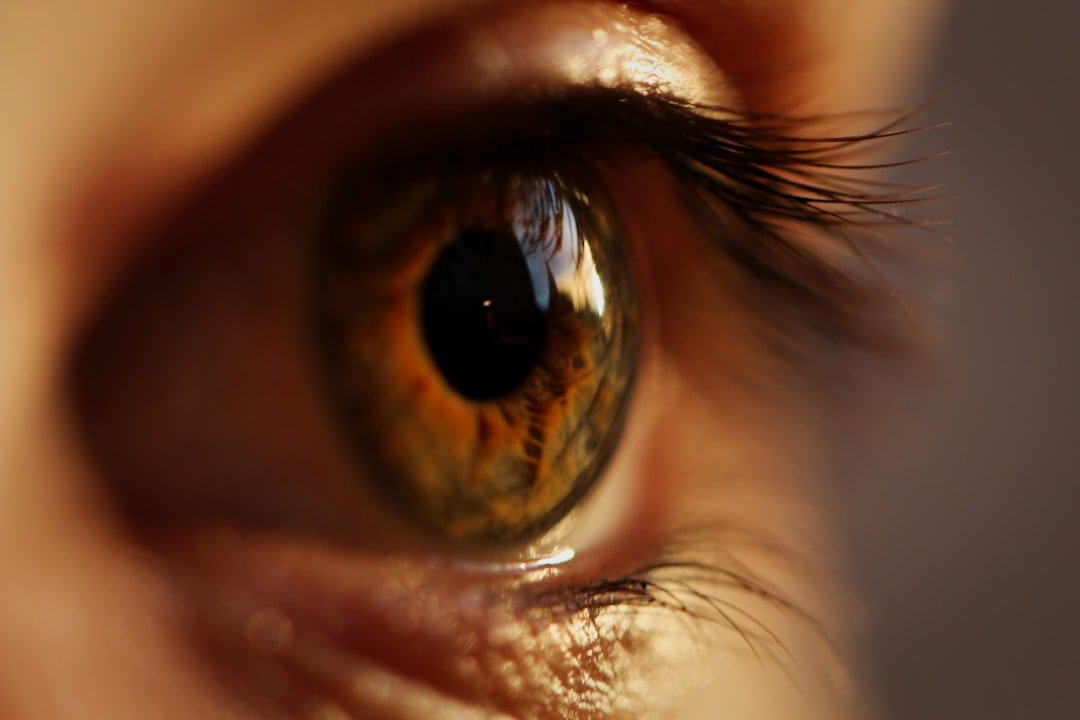
The clearest account comes from a 2005 review in Occupational and Environmental Medicine by Wolkoff and colleagues, which set out to merge indoor air science, occupational health and ophthalmology to explain work-related eye complaints.
Its conclusion is that alteration of the precorneal tear film, the thin layer of moisture covering the eye surface, leads to eye complaints. It names three groups of causes. Thermal factors, specifically low relative humidity and high room temperature. Demanding task content, because attention decreases blinking and widens the exposed ocular surface area. And individual characteristics including tear film alterations, blinking anomalies, gland dysfunctions and contact lens use.
These progressively increase water evaporation and cause faster thinning of the tear film, producing dryness and dry spot formation on the cornea.
Note the second cause. Concentrating hard reduces how often you blink and exposes more of the eye surface, which means the work itself is part of the mechanism, not just the room. That is a different route from the one dark mode research examines, which concerns display polarity rather than blinking.
What controlled comparison shows
A 2023 study compared relative humidity of 10 per cent against 45 per cent at 23 degrees, in soft contact lens wearers and non-wearers, measuring subjective sensations alongside tear film parameters and blink patterns.
Low humidity had significant effects on some measured physiological parameters in both groups. Contact lens wearers showed lower ocular surface temperature and a larger temperature differential after blinking at 10 per cent humidity, indicating faster tear evaporation, and their tear films tended to be thinner with shorter break-up times.
Non-lens wearers showed significantly higher blink frequency and longer eye-closure time at 10 per cent than at 45 per cent, which the authors describe as presumably a compensatory response to tear film disturbance.
That is a genuine physiological difference, measured directly rather than inferred from complaints. It is also a comparison against 10 per cent humidity, which is drier than most offices.
Where the evidence gets complicated

A 2017 review in Indoor Air surveys external eye symptoms in indoor environments and gives the fullest risk factor list: age, contact lenses, cosmetics, diet, draught, gender, low humidity and high temperature, medication, outdoor and combustion pollutants, and screen work. It notes these may act in a combined and exacerbating manner, and that psychological stressors may influence how symptoms are reported.
Then the part that complicates the obvious response. The review reports that although humidification by moist cool air devices has been shown beneficial for office workers, resulting in lower dry eye prevalence and a more stable tear film compared with sham, a number of studies have demonstrated the opposite, with the use of portable humidifiers associated with an increase in dry eye symptoms.
So the mechanism is clear and the intervention is not. This site has tested nothing and names no products, and the honest summary is that adding moisture to the air has produced results in both directions.
The productivity claim

A separate strand argues this affects work as well as comfort. A 2020 perspective piece argues that perceived indoor dry air, described as a top-two indoor air quality complaint, in part induced by low humidity, negatively affects office work performance.
A 2023 paper reviewing indoor humidity reports that significantly more mental distraction and fatigue, both subjectively and by pupil diameter, was observed at 20 per cent relative humidity compared with 40 per cent at 24 degrees.
Those percentages come from a single comparison reported within a review, so treat them as an indication rather than a settled effect. The same review also notes lower productivity observed at high humidity, which suggests the relationship is not simply that more moisture is better. That is a familiar shape from office temperature and stuffy air, where the striking indoor-environment numbers tend not to survive scrutiny.
When to see someone
Persistent eye discomfort is worth having looked at rather than managed by adjusting the room.
Dry eye is a recognised condition with distinct types, including evaporative and aqueous-deficient forms and gland dysfunction, and they are managed differently. The reviews above list contact lens use, medication, age and gland dysfunction among the individual risk factors, several of which are clinical matters rather than environmental ones.
If your eyes are persistently sore, gritty, watering excessively, or if your vision is affected, see an optometrist or doctor. That applies particularly to contact lens wearers, since the 2023 comparison found lens wearers showed faster tear evaporation and shorter break-up times under dry conditions.
Common questions
Does dry air actually cause eye strain?
It measurably affects the tear film, which is the mechanism behind these complaints. A controlled comparison of 10 per cent against 45 per cent relative humidity at 23 degrees found low humidity had significant effects on measured physiological parameters in both contact lens wearers and non-wearers. Lens wearers showed lower ocular surface temperature and a larger temperature differential after blinking, indicating faster tear evaporation, with thinner tear films and shorter break-up times. Non-wearers showed higher blink frequency and longer eye closure, described as presumably compensatory. Note that 10 per cent humidity is drier than most offices, so this establishes the mechanism rather than the size of the everyday effect.
Would a humidifier help?
The evidence points both ways, which is unusual for a question this simple. A 2017 review reports that humidification by moist cool air devices has been shown beneficial for office workers, producing lower dry eye prevalence and a more stable tear film compared with sham, and that a number of studies have demonstrated the opposite, with portable humidifiers associated with an increase in dry eye symptoms. This site has tested no devices and names none. Given that the same review lists a dozen risk factors that may act in a combined and exacerbating way, a single environmental fix is unlikely to be the whole answer.
Is it the air or the screen?
Both, according to the mechanism. A 2005 review concluded that tear film alteration causes eye complaints and named three groups of contributors: thermal factors such as low humidity and high room temperature, demanding task content because attention decreases blinking and widens the exposed ocular surface area, and individual characteristics including tear film alterations, blinking anomalies, gland dysfunctions and contact lens use. The task-related route matters for anyone reading this at a screen: concentrating reduces blink rate, which contributes to the same tear film instability that dry air produces. The room and the work feed one shared mechanism.
Should I see someone about it?
If it is persistent, yes. Dry eye is a recognised condition with distinct forms, including evaporative and aqueous-deficient types and gland dysfunctions, which are managed differently, so working out which you have is a clinical question. The reviews here list age, contact lenses, cosmetics, medication and gland dysfunction among individual risk factors alongside environmental ones. Persistent soreness, grittiness, excessive watering or any effect on vision is worth taking to an optometrist or doctor. That applies particularly to contact lens wearers, given the measured differences in tear evaporation and break-up time under dry conditions.
A shared mechanism, not a single cause
What makes this topic clearer than most on this site is that everyone agrees on the physiology. Tear film destabilises, evaporation increases, dry spots form, eyes hurt. That chain is well described and consistently reported.
What is not clear is which input to attack. The risk factor list runs to a dozen items acting in combination, spanning the room, the work, the body and what you put on your face. Low humidity is genuinely on it. So is concentrating hard, which reduces blinking, and which is not something you can turn down.
And the intervention that seems most obvious has a literature pointing in both directions, with humidification helping in some studies and portable humidifiers associated with more symptoms in others.
Which suggests treating dry air as one contributor rather than the explanation, and treating persistent symptoms as a clinical question rather than an environmental one. The room is worth fixing if it is uncomfortable. The eyes are worth having looked at either way.
Did this answer your question?
Thanks. That helps us decide what to fix.


Leave a comment