
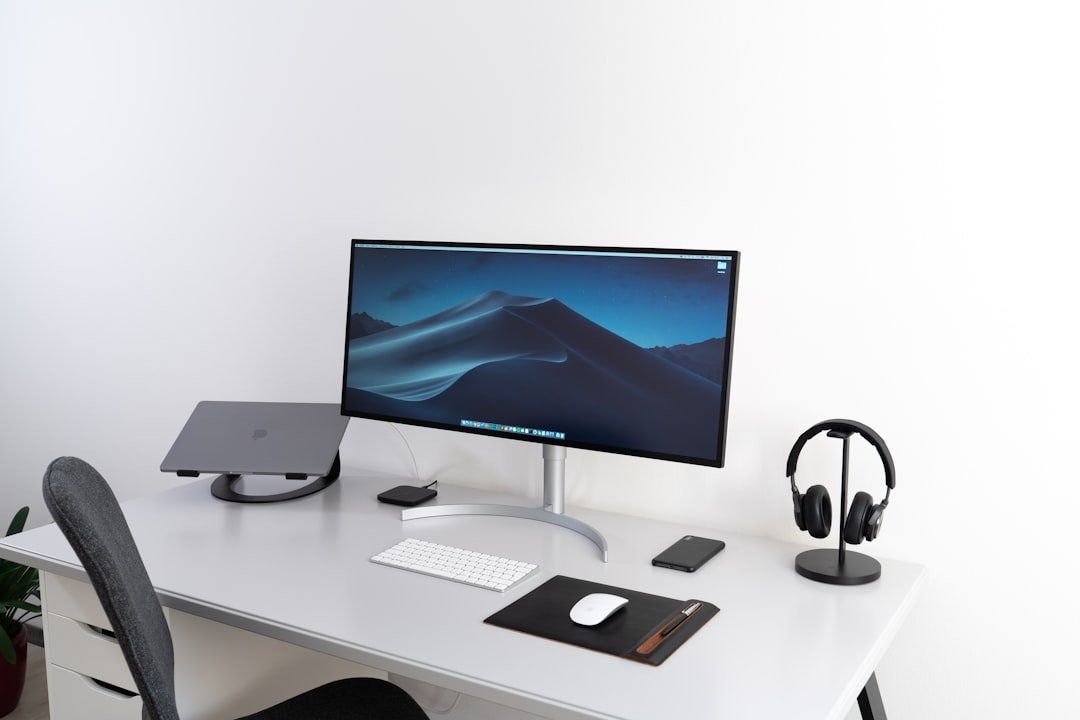
How high should your monitor be? Put the top of the screen at or just below eye level, with the centre of the display roughly 15 to 20 degrees under horizontal and about an arm’s length away. That is what OSHA and CCOHS advise, and it is a reasonable default, but it is not a clinical finding. The trial evidence that workstation geometry prevents neck or shoulder pain is thin to absent, so treat monitor height as a cheap comfort setting rather than the thing standing between you and an aching trapezius.
Your external display has been sitting on two hardback O’Reilly books since the office closed. Around three in the afternoon the ridge of muscle between your neck and your right shoulder starts to complain, and by the last review of the day it has your full attention. You search. Three pages tell you the same thing in the same voice: top of screen at eye level, buy a monitor arm, fix your posture. None of them says where the numbers came from.
How high should your monitor be? What the standards actually say

Two sources here are public and non-paywalled. OSHA’s Computer Workstations eTool advises that the top of the monitor be at or slightly below eye level, with the screen centre normally 15 to 20 degrees below horizontal eye level. CCOHS lands nearby, recommending about 15 degrees below the horizontal line, or slightly lower. Around that line it describes a preferable visual zone of 30 degrees, extending 15 degrees either side of the resting line of sight, and an acceptable zone that runs a further 15 degrees downward for a total of 45. For distance, CCOHS declines to give a fixed number and says an arm’s length is usually a good estimate.
Notice what CCOHS does that the pages copying it do not. It calls its own numbers guidelines rather than a commandment carved in stone, gives a zone instead of a point, and says outright that looking above the horizontal is tiring and that a monitor set too high is itself a source of discomfort. That kills the “higher is always better” reading. CCOHS goes further and says the discomfort from a monitor that is too high is worse than the discomfort from one that sits slightly too low. It also notes that people in bifocals or progressive lenses may find the screen more comfortable lower still.
These are occupational health recommendations built on visual comfort zones. They are not the output of trials showing that people at 15 degrees end up with fewer neck problems than people at 30. That distinction matters, because the trials that did go looking are far less encouraging than the tone of the advice implies.
What the trials found: not much, and not much of it
The reference point is a 2018 Cochrane review of 15 randomised controlled trials covering 2,165 office workers. On physical ergonomic interventions, the headline is a null. Workstation adjustment (one study) and sit-stand desks (one study) did not have an effect on upper limb pain or discomfort compared with no intervention, and there was no evidence of an effect for the other physical interventions examined.
Read that carefully, because the overclaim is easy in either direction. “One study found no effect” is not “workstation adjustment does not work.” The trial base is roughly one small study per intervention, nowhere near enough to show a benefit, and 14 of the 15 trials were judged at high risk of bias.
The one physical intervention with any signal was an arm support combined with an alternative computer mouse, pooled from two studies, which reduced the incidence of neck or shoulder musculoskeletal disorders (RR 0.52, 95% CI 0.27 to 0.99) on moderate-quality evidence, but not right upper limb disorders (RR 0.73, 95% CI 0.32 to 1.66). That first confidence interval nearly touches 1.0, and the review authors call the arm support evidence inconsistent in their own conclusions. A hint worth knowing about, not a shopping instruction.
Height specifically? The closest thing to a direct test is a laboratory study that compared three monitor heights, at sight angles of 15, 30 and 45 degrees below horizontal. Ten participants, one session. No statistically significant difference in upper trapezius EMG activity between the three settings. A significant difference in overall comfort and user acceptability, favouring the high setting.
That is the shape of this evidence: with ten people over a single session, the muscle-activity difference was not detectable and the comfort difference was. At n=10 you cannot rule out a real muscle-load effect the study was too small to see, and other work reports differences at more extreme low angles, so “monitor height never affects muscle load” is not available as a conclusion either. What you can say is that people preferred the higher screen.
Where the 60-pound number came from

Somewhere in your results is a page saying that tilting your head forward loads your cervical spine with up to 60 pounds. That figure traces to a short 2014 paper by Hansraj in Surgical Technology International, which set out to calculate forces from a computer model of the spine rather than to measure anything in human subjects. The retrievable record is a three-sentence preamble with no results section at all, in a three-page article.
It appears here only so you can see the provenance of a number repeated at you as if it were a measurement of your neck. It is not one. The causal story it props up has not fared well either: a cross-sectional study of 150 young adults aged 18 to 21 found no association between texting posture and neck pain, whether posture was rated by self-perception or by physiotherapists, across all four adjusted regression models. Cross-sectional work on a young sample with self-reported pain cannot prove posture is harmless. It can show the “text neck” causal claim is not established, and it does.
What actually predicts who gets neck pain

If screen geometry is not load-bearing, what is? A systematic review of prospective cohort studies of office workers found strong evidence for exactly two predictors of the onset of non-specific neck pain: female gender, and a previous history of neck complaints. Factors named as causes constantly, including high psychosocial stress and low social support, had no predictive value there. The authors call the literature scant, with only five high-quality and two low-quality cohorts available, and “no predictive value was found” means the studies did not detect an association, not that the factor is proven irrelevant.
One postural variable does turn up, pointing the opposite way from the usual advice. In a one-year prospective cohort of 669 healthy office workers, the predictors of developing chronic neck pain were high body mass index, frequent neck extension during the work day, high initial pain intensity, and high psychological job demands. Neck extension is what you do when the screen is too high: chin up, head tipped back. This is observational, and these predict chronicity among people who already developed pain rather than proving extension causes it. Still, it is the only geometry-adjacent finding in the prospective literature.
So two independent things point the same direction. CCOHS says on its own authority that too high is worse than slightly too low. The cohort above puts frequent neck extension on a list of predictors. My own inference from putting those together, and I am flagging it as reasoning rather than a finding, is that if you are going to miss the zone, miss it low. Nothing in the packet tests that directly, and you can read how we handle evidence like this if you want the working.
The intervention with the best evidence is not a piece of furniture

For people who already have chronic neck pain, a Cochrane review of 27 trials on exercise for mechanical neck disorders found moderate-quality evidence that cervico-scapulothoracic and upper extremity strength training improves pain by a moderate to large amount immediately post-treatment and at short-term follow-up (pooled SMD -0.71, 95% CI -1.33 to -0.10). Stretching alone drew low-quality evidence that it may not change pain or function over the same window.
The authors open their own conclusion with this: no high quality evidence was found, indicating that there is still uncertainty about the effectiveness of exercise for neck pain. Quote the effect size and you have to quote that sentence with it. Note the scope too. This is treatment for existing chronic neck pain, not prevention.
One boundary before the questions. If your pain radiates down an arm, or you have numbness, tingling or weakness, or the pain followed an injury, that is a conversation with a clinician rather than a desk adjustment. Nothing here is medical advice, and our medical disclaimer says so at greater length.
Common questions
Should the top of the monitor be at eye level or above it?
At or slightly below eye level, per OSHA’s Computer Workstations eTool, with the screen centre normally 15 to 20 degrees below horizontal. CCOHS warns that looking above the horizontal is tiring and that a monitor set too high is itself a source of discomfort, worse than one sitting slightly too low, so above eye level is not the safer error. These are occupational health guidance ranges rather than trial results, and no trial in this evidence base shows that hitting them prevents neck pain.
Will raising my monitor fix my neck pain?
There is no good evidence that it will. In a 2018 Cochrane review of 15 randomised trials covering 2,165 office workers, workstation adjustment (one study) and sit-stand desks (one study) showed no effect on upper limb pain, and 14 of the 15 trials were judged at high risk of bias. That is an absence of demonstrated benefit from a thin trial base, not proof that adjustment is useless. If the screen is currently too high, note that raising it further is the direction CCOHS warns against.
Does monitor height change how hard my neck muscles work?
In a laboratory study of ten computer users over a single session, comparing sight angles of 15, 30 and 45 degrees below horizontal, there was no statistically significant difference in upper trapezius EMG activity between the three heights, though comfort and acceptability were significantly higher at the high setting. With ten participants, that null cannot rule out a real effect, and other studies report differences at more extreme low angles.
Do I need a monitor arm, or will a stack of books do?
A monitor arm is one mechanism for putting a screen inside the guidance range; books and risers are others, and no trial evidence favours one mechanism over another. TorpidLife has tested no hardware and recommends no model. The only arm-related finding in the 2018 Cochrane review concerns a forearm support used alongside an alternative mouse, which is a different product doing a different job, and the review authors call that evidence inconsistent.
Is bad posture causing my neck pain?
The prospective evidence does not support that framing. A systematic review of prospective cohort studies of office workers found strong evidence for only two predictors of neck pain onset, female gender and a previous history of neck complaints, and the authors describe the literature as scant, resting on five high-quality and two low-quality cohorts. An undetected association is not proof that posture is irrelevant, but nobody should be telling you your pain is your posture’s fault.
Set the screen inside the zone, err low rather than high, and stop treating the number as a diagnosis. Monitor height is a cheap, reversible adjustment with a comfort signal behind it and no demonstrated preventive effect, which is reason enough to get it roughly right and no reason at all to spend another evening reading about it. The uncomfortable part is that the variables with the strongest signal are ones a desk cannot touch: what your neck has already been through, and, if you already hurt, strength work you have to actually do. For a workstation variable with a better-studied outcome attached, how often you get out of the chair has its own trial evidence, and the visual side of the screen is a separate question entirely.
Leave a Reply