
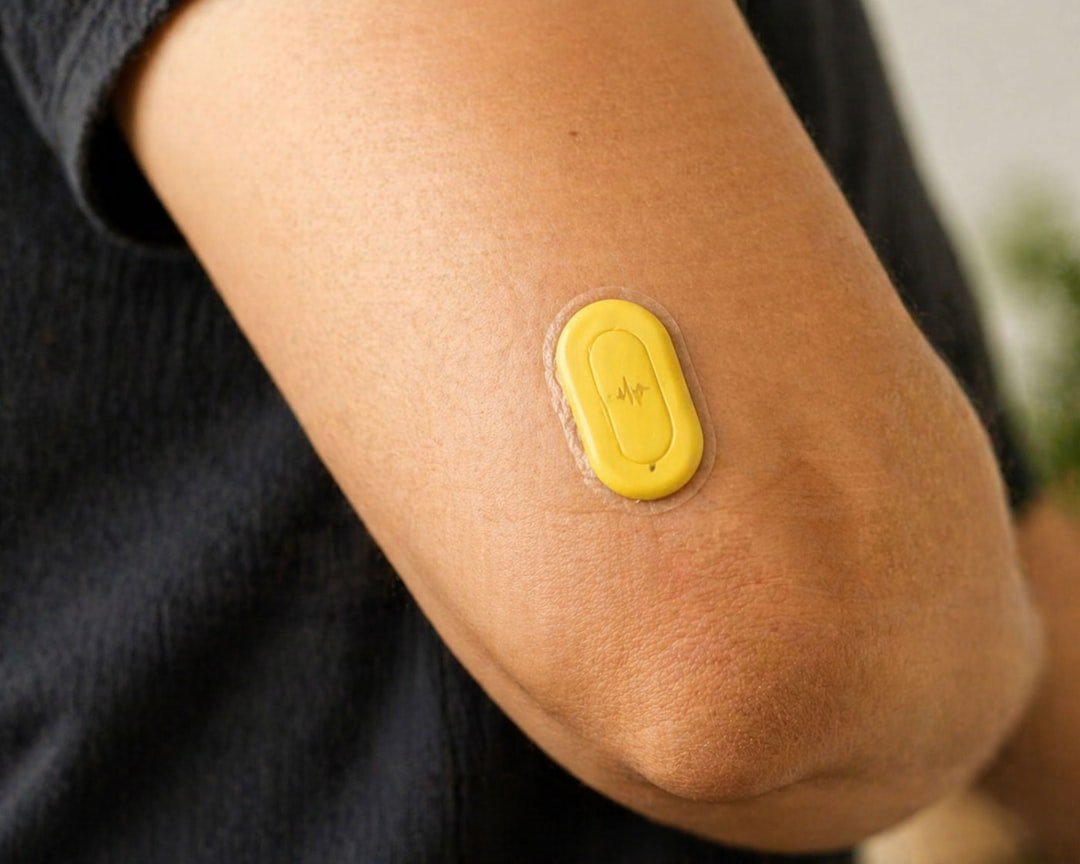
For most healthy people, no. A continuous glucose monitor (CGM) will show you a number that rises after meals and falls again, which is what a working pancreas does. The devices are accurate and legitimately useful for people with diabetes, and there is modest trial evidence that glucose feedback nudges glycaemic control in people who already have a problem. What does not exist is controlled evidence that a healthy desk worker who watches their glucose for a month ends up healthier, more energetic or more focused. The interpretation layer sold with the sensor (spike scores, steadiness targets) runs well ahead of the science.
What you are actually buying
Two over-the-counter CGMs dominate the “metabolic health” market. Dexcom’s Stelo was the first cleared in the US. The FDA’s March 2024 clearance describes it as an integrated CGM “intended for anyone 18 years and older who does not use insulin, such as individuals with diabetes treating their condition with oral medications, or those without diabetes who want to better understand how diet and exercise may impact blood sugar levels”. Each sensor lasts up to 15 days and the app “presents blood glucose measurements and trends every 15 minutes”. The FDA also warns that “this system is not for individuals with problematic hypoglycemia (low blood sugar) as the system is not designed to alert the user to this potentially dangerous condition”. The agency has since extended the Stelo clearance to children as young as two who do not use insulin.
Dexcom sells Stelo at $99 for a two-sensor pack, or $89 a month on subscription, with marketing that promises to reveal “how food, exercise and sleep can affect glucose” (Dexcom investor site, accessed 13 September 2026). Abbott’s Lingo, the other main over-the-counter entrant, is sold on the same promise: flag your glucose “spikes” and coach you toward steadier levels.
Note what the regulator cleared and what the marketing sells. The FDA cleared a measuring device. The spike scores and steadiness targets are the manufacturers’ interpretation, and the clearance does not validate them.
What normal glucose looks like in people without diabetes
The best reference data come from a 2019 multicentre study that fitted 153 healthy, non-diabetic people aged 7 to 80 with a blinded Dexcom G6 for up to 10 days. Their median time between 70 and 140 mg/dL was 96% (interquartile range 93 to 98). Median time above 140 mg/dL was 2.1%, about 30 minutes a day, and the average within-person coefficient of variation was 17 ± 3%. In other words, healthy glucose is not flat. It moves by around a sixth of its mean over a day, and it spends half an hour or so above the threshold that consumer apps tend to colour red.
That study used a lean, screened cohort. A larger community sample looked less tidy. In a 2025 analysis of more than 1,000 people without diabetes from a US cohort study, normoglycaemic participants (mean age 58.5) spent 87.0% of the time between 70 and 140 mg/dL, and roughly 3 hours a day (12.1% of the time) above 140 mg/dL. These were people who passed the standard diagnostic tests for diabetes. Three hours a day over 140 was their normal.
So the first thing a healthy person learns from a CGM is that their glucose goes up after eating. That is not a finding. It is physiology.
Does watching the number change anything?
The strongest evidence is a 2024 systematic review and meta-analysis of randomised trials that used CGM feedback specifically as a behaviour-change tool. It pooled 25 trials with 2,996 participants. CGM feedback reduced HbA1c by 0.28% (95% CI 0.15 to 0.42) and increased time in range by 7.4% (95% CI 2.0 to 12.8), “with non-significant effects on time above range, BMI, and weight”.
Read the population before you read the effect. Most trials (17 of 25, 68%) were in people with type 2 diabetes; only 3 of 25 were in people with overweight or obesity and none was in metabolically healthy adults. Eleven of the 25 (44%) reported conflicts of interest with CGM manufacturers. And the behavioural outcomes the devices are sold on were barely measured: “Only 4/25 studies evaluated the effect of CGM on dietary changes; 5/25 evaluated physical activity.” The authors’ own conclusion is that further research “in populations without diabetes is needed”.
A 0.28% drop in HbA1c is a modest, real benefit for someone whose HbA1c is 8%. For a healthy person at 5.2%, it is close to meaningless, and no trial has tested whether it happens at all.
A 2025 systematic review of CGM in people without diabetes, framed around cardiovascular prevention, put it plainly: “Several biotech companies are marketing CGM to healthy individuals, warning of glucose spikes and promising weight management and PA integration aid”, but “Scientific proof, however, is lacking”. That review appeared in an MDPI journal, which we would not normally lean on; we cite it here because it is on PubMed Central and because its verdict matches the trial literature above.
Where the spike narrative comes from, and why it overreaches
The idea underneath consumer CGM marketing is that post-meal glucose peaks in healthy people are harmful in themselves, and that flattening them improves energy, weight and long-term health. The chain of reasoning borrows from diabetes research, where glycaemic variability is associated with complications, and applies it to people whose glucose behaves very differently: in the community cohort above, participants with diabetes spent 46.2% of the time in the 70 to 140 mg/dL range, against 87.0% for those without.
Two problems. First, association in diabetic cohorts does not transfer to causation in healthy ones. Second, the interpretation layer is unvalidated. No published trial has tested whether chasing a lower spike score, or keeping a Stelo trace inside a coloured band, changes any health outcome in a person without diabetes. The manufacturers do not claim otherwise in their regulatory filings; the claims live in the app copy.
For the desk worker who wants to understand a 3pm slump, the honest reading is that a CGM will show a post-lunch rise and fall, which happens in everyone, and will not tell you whether that rise caused the slump. There are better-evidenced explanations for the afternoon dip; see why do I get tired after lunch.
The cost side: money, attention and false alarms

A subscription is roughly $1,000 a year. The less obvious cost is attention. A device that reports every 15 minutes and flags every rise above 140 mg/dL will, in a healthy person, flag several times a day, because that is what the reference data say healthy people do. Whether that produces useful insight or unnecessary worry has not been studied in a controlled way, so we will not claim it does either. What we can say is that the readings will be mostly normal, and the app may not label them that way.
There is also a floor effect: the FDA excludes the device from use in anyone prone to low blood sugar because it does not alarm for it, so it is not a safety net.
When a CGM might make sense
The honest use cases are narrow. If you have prediabetes or type 2 diabetes not on insulin, the trial evidence above applies to you and the modest gains are real; discuss it with your clinician rather than buying one on impulse. If you are a healthy person with a specific, time-limited question (how does a particular meal or workout affect me), a single two-week sensor answers it without a subscription. Beyond that, the device is measuring something your body already regulates, and the number it gives you has no validated meaning for your health.
For how we weigh manufacturer claims against trial data, see how we research. If you have any diagnosed condition or take glucose-lowering medication, talk to a clinician before acting on any wearable’s readings.
Common questions
Is it normal for glucose to go above 140 after eating if you do not have diabetes?
Yes. In a study of 153 healthy non-diabetic people, median time above 140 mg/dL was about 30 minutes a day, and in a community cohort of more than 1,000 people without diabetes it averaged around 3 hours a day. A post-meal rise is expected. Persistent fasting elevation is a different matter and needs a clinical test, not a wearable.
Does a CGM help you lose weight or eat better if you are healthy?
There is no controlled evidence that it does in healthy adults. A 2024 meta-analysis of 25 randomised trials found modest glycaemic improvements, mostly in people with type 2 diabetes, with no significant effect on weight or BMI, and only 4 of 25 trials measured diet at all. The authors say research in people without diabetes is still needed.
What is a normal glucose variability on a CGM?
In healthy, non-diabetic adults wearing a Dexcom G6, the average within-person coefficient of variation was 17% and median time between 70 and 140 mg/dL was 96%. Consumer apps do not always use these reference ranges, so a reading the app colours as a spike may fall well inside what researchers consider normal.
Is the Stelo or Lingo CGM FDA approved for people without diabetes?
Stelo is FDA cleared for anyone aged 18 or over who does not use insulin, including people without diabetes who want to see how diet and exercise affect glucose. The clearance covers the sensor’s measurement, not the app’s spike scores or coaching, and it excludes people with problematic hypoglycaemia because the device does not alarm for lows.
Can a CGM cause anxiety about normal glucose readings?
That question has not been studied in a controlled trial, so we cannot give you a number. What the reference data show is that healthy people exceed 140 mg/dL for between 30 minutes and 3 hours a day, so an app that flags every excursion will flag normal physiology. If the readings worry you, the fix is a clinical test with your doctor, not more sensor data.
Did this answer your question?
Thanks. That helps us decide what to fix.



Leave a comment